About
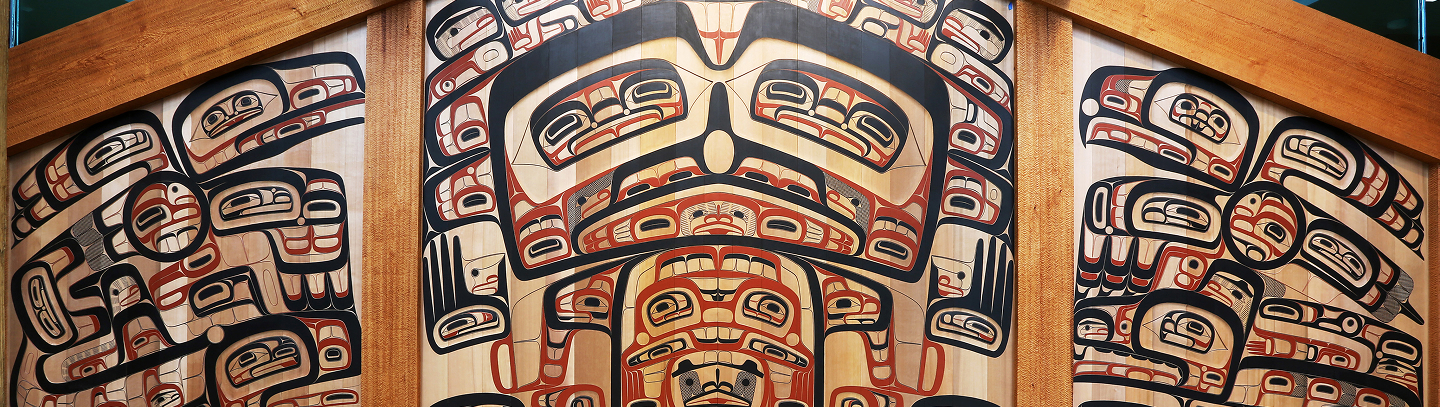
Upon entering the Walter Soboleff Building foyer, visitors will see an enormous carved-and-painted Tsimshian clan house front by Tsimshian artist David A. Boxley, an internationally-recognized master artist. At almost 40 feet wide by 15 feet high, Boxley’s piece—which he made with his son, Tsimshian artist David R. Boxley—is thought to be the largest, carved-and-painted Tsimshian house front in the world.
The Boxleys’ design was inspired by the style and complexity of old Tsimshian house fronts. The center of the house front tells the Tsimshian story “Am’ala: Wil Mangaa da Ha’lidzogat” (“Am’ala: He Who Holds up the Earth”). A central figure is shown as a giant supernatural being who represents the land. The Tlingit, Haida, and Tsimshian people are represented along the top. Am’ala is on his back balancing the world on a stick propped on his chest. It is said that when Am’ala coughs, an earthquake ensues. A tiny door in the belly of Am’ala leads into the clan house, formally named Shuká Hít (Ancestors’ House) in a ceremony. The sides of the house front depict the four Tsimshian crests—Raven and Killerwhale on the left and Eagle and Wolf on the right. The secondary crests—Frog, Grizzly Bear, Beaver, and Black Bear—are represented in the eyes of Raven, Killerwhale, Eagle, and Wolf respectively. The circle design on the left side was copied from an old photo that showed the remains of a Tsimshian house front from the 1800s. The circle was the only piece of the design that remained on the old front, and the Boxleys featured it in their work to honor the old Tsimshian carvers.