
About
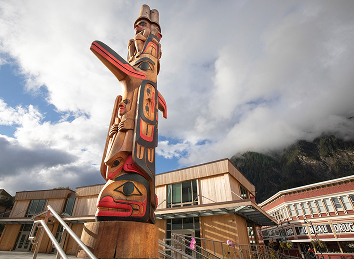
Since 2022, Sealaska Heritage has raised 14 totem poles along the Juneau waterfront as part of Kootéeyaa Deiyí (Totem Pole Trail), which is part of our vision to make Juneau the Northwest Coast arts capital. The goal is to eventually raise a total of 30 totems.
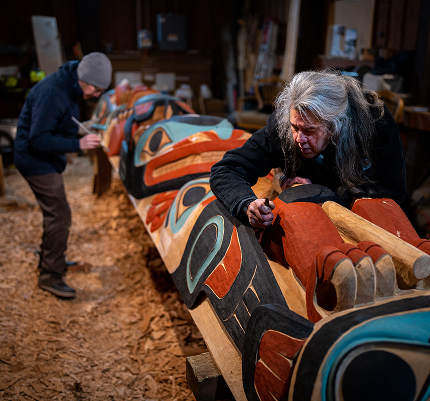
Northwest Coast art evolved over several thousand years in the rich and complex Indigenous societies of the Pacific Northwest of North America. Wood carvings, weavings, and other cultural pieces depicting Northwest Coast art were aggressively collected by museums and Western explorers and acclaimed as one of the most distinctive and unique art traditions in the world. One of the most widely known art forms in Northwest Coast art is the totem pole. Totem poles were carved from large red cedar trees and erected in front of Native villages, welcoming visitors who arrived by sea. The totem poles were carved with the crests and spirits of our clans and depicted significant events and clan histories.
Watch a short video about totem poles!
Explore Kootéeyaa Deiyí
Guide & Map
SHI’s Kootéeyaa Deiyí (Totem Pole Trail) features 14 totem poles along the Juneau waterfront and at Atnané Hít (Sealaska Heritage Arts Campus) plaza made by Tlingit, Haida, and Tsimshian master artists and their apprentices. SHI plans to eventually install 30 totem poles, an ancient art form that evolved over several thousand years in the rich and complex Indigenous societies of the Pacific Northwest. Historically, totem poles were carved with the crests and spirits of clans and depicted significant events and clan histories. Explore Kootéeyaa Deiyí using our pocket guide!
Watch the Opening Ceremony
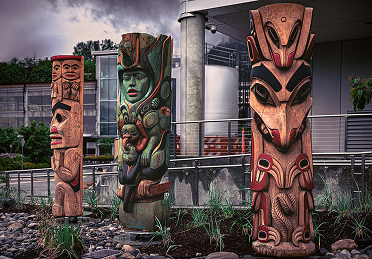
In 2023, hundreds of people gathered to witness a dedication ceremony for the first 13 of 30 totem poles raised in downtown Juneau. The ceremony featured dance performances and comments from dignitaries as well as ceremonial rites such as imitating the spirits of and thanking and feeding the spirits of the trees.
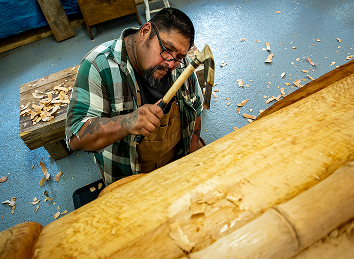
Hear From the Carvers
This documentary highlights the installation of the first 13 of 30 totems for Kootéeyaa Deiyí and features interviews with the master carvers and their apprentices, who talk about their journeys as artists and the project itself.
To learn more, select a totem.
Choose an installation to read its details. Use arrow keys between choices when enhanced.
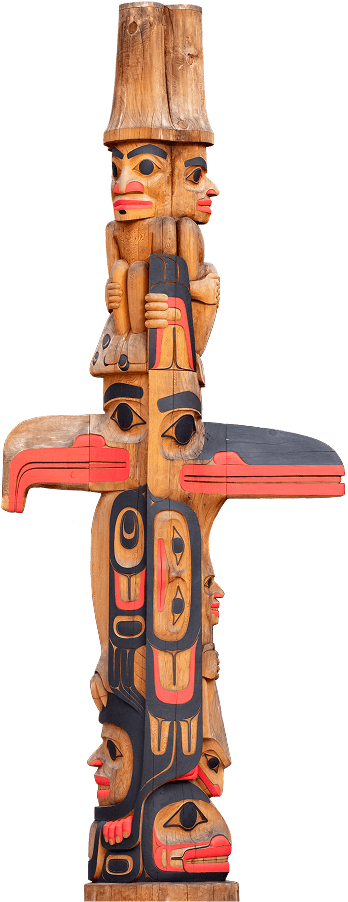
Sealaska Cultural Values Pole
This rare style of pole, which is carved on all sides, is the first of its kind in Alaska. The pole represents all three tribes of Southeast Alaska—Tlingit, Haida, Tsimshian—and their four cultural values:
- Haa Aaní: Honoring & Utilizing Our Land
- Haa Latseení: Strength of Body, Mind, & Spirit
- Haa Shuká: Honoring our Ancestors & Future Generations
- Wooch Yáx̱: Social & Spiritual Balance
Design: The pole features (top to bottom) three human figures, an Eagle and Raven, “Strong Man” ripping a sea lion in half, sun and moon within the Raven wings, salmon, and man holding up the world.

Tlingit Eagle Pole
The Eagle and Raven poles honor the Eagle and Raven clans that once were present among our Tlingit, Haida, and Tsimshian cultures. They include the crests used by clans of both moieties. The diseases brought by Westerners in the 1800s significantly impacted Native communities and the Native population. The population was reduced by nearly 50 percent and a number of villages were abandoned. Some clans became extinct or were severely diminished in numbers and never fully recovered. Other clans that survived continue to use these crests. These poles are dedicated to the Tlingit Eagle and Raven clans and to the ancestors of these clans.
Design: Eagle, Wolf, Killer Whale, Thunderbird, Brown Bear.

Haida Raven Pole
The Haida of Southeast Alaska, known as the Kaigani Haida, migrated from Haida Gwaii in Canada to Southeast Alaska in the late 17th century and settled in several different sites on Prince of Wales Island, largely concentrated in Hydaburg, Kasaan, and Craig.
Design: The Haida Raven totem pole includes the Raven, Butterfly, Wolf, Killer Whale, and Bear, which were obtained through supernatural encounters. The Haida believe that everything has a spirit, including elements of the universe such as the sun, moon, and stars.

L’eeneidí Pole
The L’eeneidí clan are of the Raven moiety. Their name derives from Teel’ Héeni (Dog Salmon Stream). They primarily live in the Áak’w Ḵwáan region and in what is now known as the Juneau Indian Village.
Design: The designs on the L’eeneidí pole include four of their crests. The top design features a Star, which derives from one of their clan houses known as “Little Dipper House.” Below that are a Dog Salmon and Lucky Lady, which were obtained through supernatural encounters. It also depicts a L’eeneidí clan member. The lower design features Raven with the Box of Daylight. According to oral tradition, Raven opened the Box of Daylight and released the Sun, bringing daylight to the world.

Wooshkeetaan Pole
The Wooshkeetaan clan are of the Eagle moiety. A living history and legendary migration persists in the story of a name, Wooshdaxk’i Tláa (Mother of Two Clans, a name carried today by a Kaagwaantaan woman) who was part of a group who left Gatheeni (Glacier Bay) after the ice fields began to advance.
Design: The designs on the Wooshkeetaan pole include three of their crests. The Eagle crest represents their moiety membership, Berners Bay Mountain represents their ancestral homeland, which continues to be a sacred place for the Wooshkeetaan, and the Shark crest was obtained through a supernatural encounter.

Kaagwaantaan Pole
The Kaagwaantaan, who are of the Eagle moiety, are identified as the Wolf clan. They migrated northward from the Naas River and settled at Kax’noowu (Ground Hen Fort). They spread to Hoonah, the Chilkat area, and Sitka.
Design: The designs on the Kaagwaantaan totem pole include three of their crests: a Killer Whale is mounted on a clan hat, a Kaagwaantaan clan member, a Killer Whale, an Eagle, and a Bear. These crests were obtained through supernatural encounters.

Sukteeneidí Totem Pole
The Sukteeneidí, who are of the Raven moiety, use the dog salmon as their primary clan crest. The translation of Sukteeneidí is Dog Salmon in tall grass at the mouth of a creek prior to swimming upstream to spawn. Their ancestral homelands are in Tebenkof Bay, Kuiu—also known as the area of Kake. The Sukteeneidí migrated to Prince of Wales Island in southern Southeast Alaska. Early accounts describe the clan’s efforts to mitigate social and cultural conflicts they encountered with western explorers and Christian institutions.
Design: The design on the Sukteeneidí pole includes a clan leader holding a dog salmon staff, Raven sitting on top of a bentwood box, a shaman named Xaa Tinch holding a snail shell rattle (an important clan crest), another clan leader from the 1850s, and dog salmon swimming through grass. Xaa Tinch had a vision of beings coming to their land bringing a symbol that was discovered to resemble a cross. The shaman is wearing a bear claw headdress, ivory nose piercing, copper tinaa earrings, tattoos of Raven on his arms, and he is holding ivory charms or amulets in one hand and a snail shell rattle in the other.

Tlingit Raven Pole
The Eagle and Raven poles honor the Eagle and Raven clans that once were present among our Tlingit, Haida, and Tsimshian cultures. They include the crests used by clans of both moieties. The diseases brought by Westerners in the 1800s significantly impacted Native communities and the Native population. The population was reduced by nearly 50 percent and a number of villages were abandoned. Some clans became extinct or were severely diminished in numbers and never fully recovered. Other clans that survived continue to use these crests. These poles are dedicated to the Tlingit Eagle and Raven clans and to the ancestors of these clans.
Design: Diving Whale, Raven, Frog, Beaver, Salmon.

L’uknax̱.ádi Pole
The L’uknax̱.ádi, who are of the Raven moiety, are identified as the Coho clan. The name derives from a salmon stream south of Klawock. They separated from the Gaanax̱teidí clan after they migrated to the Chilkat area.
Design: The designs on the L’uknax̱.ádi totem pole include a White Frog, which was obtained through a supernatural encounter, Raven, Coho, and a clan member.

Shangukeidí Pole
The Shangukeidí, who are of the Eagle moiety, are identified as the Thunderbird clan. Their oral traditions vary in identifying the clan’s original homeland, which includes migration from the Naas River in British Columbia and a coastal migration.
Design: The designs on the Shangukeidí totem pole include four of their crests. The Thunderbird, White Bear, and House Lowered from the Sun were obtained through supernatural encounters. The bottom crest represents a historical encounter with a US military officer who failed to adequately compensate the Shangukeidí. As payment for this debt, they took his name and the military uniform.

Ishkaahíttaan Pole
The Ishkaahíttaan clan are of the Raven moiety. Their name derives from Ishkahít (House on a Fish Hole) that was located on the east bank of the Chilkat River. They live primarily in the Taku and Teslin regions of Southeast Alaska including the Juneau-Douglas area.
Design: The designs on the Ishkaahíttaan totem pole include three of their crests. At the top is the Raven with the Box of Daylight, where Raven opened the box and released the Sun, bringing daylight to the world. The other two crests are the Frog and Sea Lion, which were obtained through supernatural encounters.

Tsimshian Pole
A group of Canadian Tsimshian migrated from their homeland to Southeast Alaska with a missionary in 1887 when their cultural traditions were banned. They settled in Metlakatla, on Annette Island. The Tsimshian, nevertheless, continued to maintain their cultural values and beliefs. Today they are renowned for their Northwest Coast arts.
Design: The designs on the Tsimshian totem pole symbolize the four Tsimshian clans: Raven, Killer Whale, Eagle, and Wolf. Each of these four clan crests is paired with another figure: Killer Whale with Grizzly Bear, Raven with Frog, Eagle with Beaver, and Wolf with Crane. Like the Tlingit and Haida, the Tsimshian believe that everything has a spirit and their ancestors had spiritual encounters with these animal beings, which allowed the Tsimshian to claim them as crests.

Haida Eagle Pole
The Haida of Southeast Alaska, known as the Kaigani Haida, migrated from Haida Gwaii in Canada to Southeast Alaska in the late 17th century and settled in several different sites on Prince of Wales Island, largely concentrated in Hydaburg, Kasaan, and Craig.
Design: The Haida Eagle totem pole depicts a classic Eagle clan hat, the Eagle crest, a Frog, Beaver, and Bear, all of which they obtained through supernatural encounters. The Haida believe that everything has a spirit, including elements of the universe such as the stars, moon, and sun.