
About
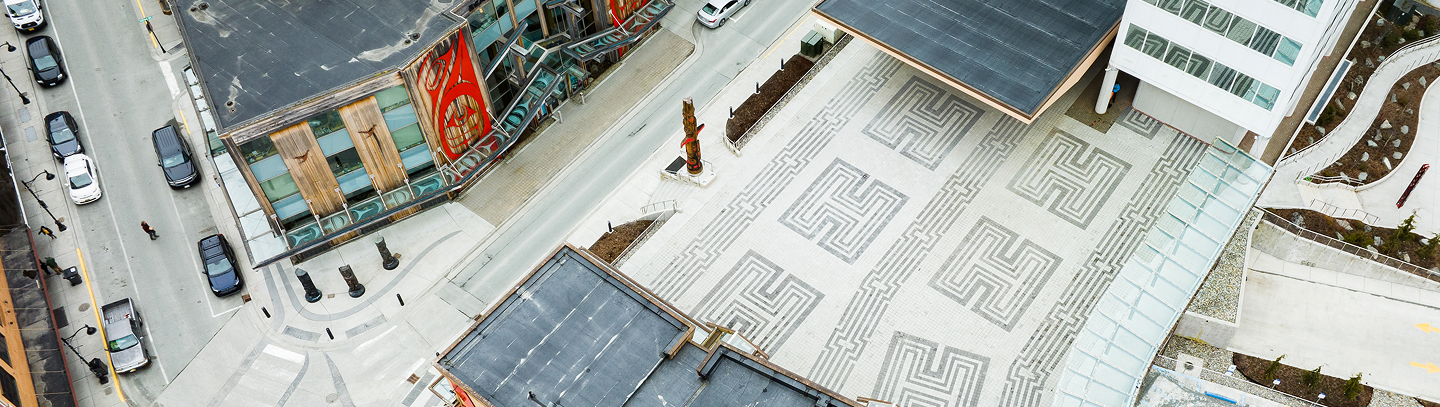
SHI’s buildings themselves are evocative of historical Northwest Coast architecture and art objects.
The Walter Soboleff Building is clad in cedar and reminiscent of a traditional clan house. The campus building is modeled after three bentwood boxes, which traditionally held sacred objects (at.óow in Tlingit). The word at.óow—literally “that which was paid for,” usually with the life of a clan ancestor—refers to items of tangible and intangible property that embody the history of the clan and the spirits of clan ancestors. At.óow can include clan hats and other ceremonial objects, crest designs, geographic sites, spirits, personal names, stories, and songs. When people bring out at.óow, they are bringing out the spirits of the ancestors.
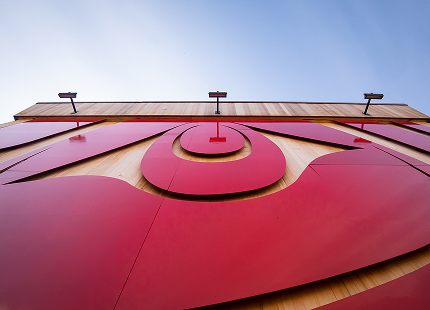
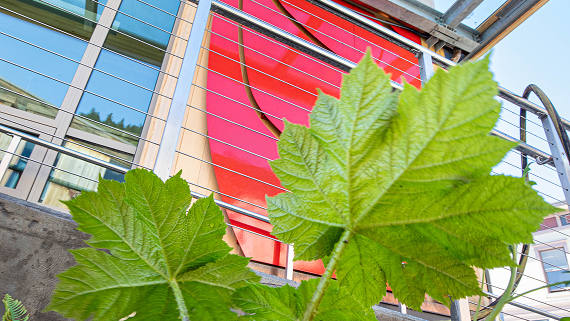
The Walter Soboleff Building, the Sealaska Heritage Arts Campus, and the Indigenous Science Building feature huge panels designed by Haida artist Robert Davidson, an internationally-celebrated master artist whose numerous totem poles stand in sites in Canada and the United States and whose art is in the collections of many major museums. The installation was based on his original painting Greatest Echo, which the artist donated to SHI’s Tináa Art Auction, a fundraiser for the Walter Soboleff Building.
The design represents a supernatural being called Greatest Echo—a theme chosen by Davidson because Dr. Walter Soboleff, the building’s namesake, “echoed the past to bring it to the present,” Davidson said. The design was replicated in metal, a medium recommended by the institute’s Native Artist Committee.
Greatest Echo
Master Haida artist Robert Davidson designed the monumental panels that adorn SHI’s three buildings. In this interview, he talks about the original design, how it was adapted to fit the outside of the Walter Soboleff Building, the origins of Northwest Coast art, and Haida culture.
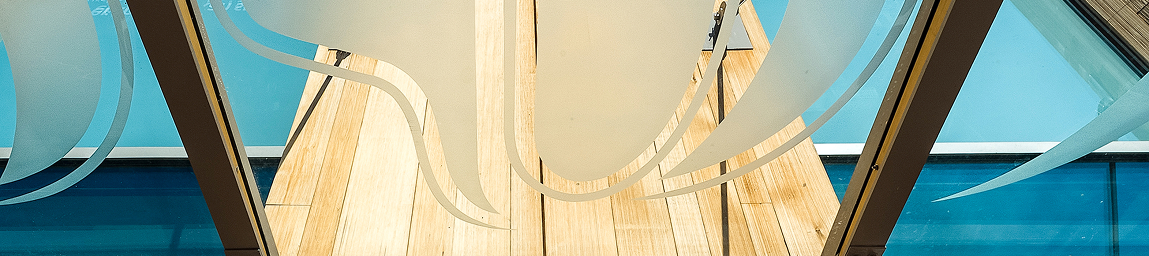
The glass awnings on the Walter Soboleff Building were engraved with formline designs made by Steve Brown, a formline expert, author, and honorary member of SHI’s Native Artist Committee. The term “formline design” describes the unique shapes that give Northwest Coast art its distinctive look. When illuminated from above, the designs in the awnings are cast onto the building and sidewalks.
The clan house features cedar panels hand adzed by master Tlingit carver Wayne Price. Adzing is an old art practice and is commonly seen in Northwest Coast pieces. In this video short, Price talks about how once Northwest Coast Native people learned to adze, everything else followed, including clan houses, totem poles, and dugout canoes.
The buildings also feature cultural aspects, such as devil’s club branches, which ward off evil spirits. Visitors might also notice handprints on the exteriors of the Sealaska Heritage Arts Campus and Indigenous Science Building and in the clan house of the Walter Soboleff Building. SHI’s Council of Traditional Scholars selected Tlingit leader Albert Kookesh to make the handprint in the clan house, along with his grandchild, to honor his work in fighting for Alaska Native rights. The inclusion of a handprint or “X” in a building is an ancient practice that denotes ownership of a place.