About
SHI is guided by a Southeast Regional Language Committee, which helps steer the institute’s language programs. The committee represents Lingít, X̱aad Kíl, and Shm’algyack speakers and learners working together to support language revitalization across Southeast Alaska.
Shm’algyack—Tsimshian
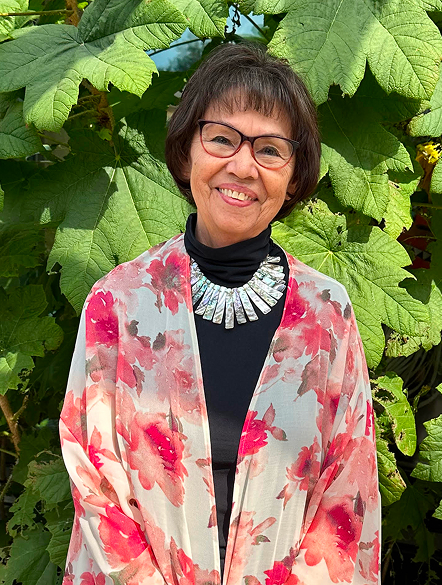
Donna May Roberts’ Tsimshian name is Shu Guyna, which means New Path, and is Gganhaada of the Gilu’tsaaw Tribe, House of Niskimas. She was raised by her grandmother, Martha Fawcett Sumner, who was one of the original Tsimshian Pioneers that moved from Old Metlakatla, British Columbia, to New Metlakatla, Alaska, in 1887.
Sumner was 6 years old at the time and retained her original language for her entire life. Teaching was introduced to Donna May at the age of 13, when an Elder told her she should teach the piano. That became her fall-back occupation throughout her life and fit well with teaching Shm’algyack since 1992. She developed a teaching philosophy which recognized that stress could play a major factor in learning and sought to find a method that would cut down the amount of anxiety that naturally occurs in a learning situation, not only for Shm’algyack (the language of the Tsimshian), but for music as well. To that end she has tried many techniques and settled on a method called Total Physical Response (TPR).
It uses an approach that mirrors the way children learn their first language. That simple philosophy made sense because all learners acquire their original language the same way. As a supplemental teaching method, she also uses the Second Language Acquisition (SLA) method, which primarily uses pictures. Currently she is involved with developing curriculum with the Teaching Proficiency through Reading and Storytelling (TPRS) method.
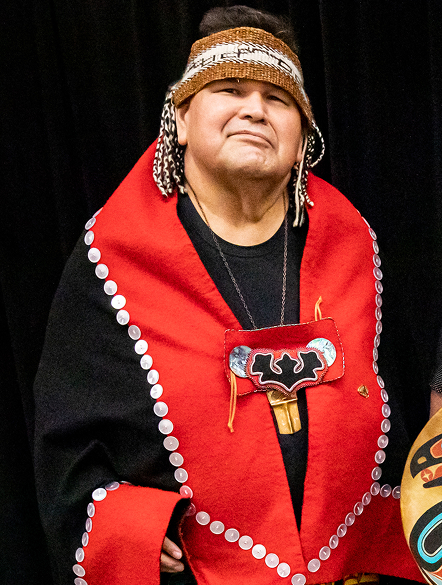
Shiggoap (Alfie Price) is Ts’msyen, Haida, and Tlingit. He is Gishbutwada, Ts’msyen Killerwhale clan, Gitlaan Tribe from the House of the Blue Billed Duck. He’s one of the co-founders of the Juneau Shm’algyack (Ts’msyen language) learners’ group, which was founded in 2015. He works in information technology for Tlingit & Haida Central Council and is an adjunct instructor of Shm’algyack at the University of Alaska Southeast. He enjoys photography and learning languages. Shiggoap is a member of Yees Ku.Oo Dancers and is an assistant leader in Ldakát Naax Sati’ Yatx’i (All Nations Children Dancers) and a Big Brother. Most importantly to him, he is the father of two: T’oxda Xsgiiga Hoon (Katy Price) and Ksibuu Aks (Joel Price), both Laxsgiik (Ts’msyen Eagle clan).
X̱aad Kíl—Haida
Skíl Jáadei (Linda Schrack) was born and raised in Southeast Alaska. She is Haida from the Shark House and a member of the Yahkw Janáas clan, Raven moiety. Skíl Jáadei is a term assistant professor of Alaska Native languages for the University of Alaska Southeast (UAS) and has been teaching X̱aad Kíl at UAS since 2014.
She has a master of arts in Indigenous languages and linguistics from Simon Fraser University. Skíl Jáadei worked for the Ketchikan Indian Community Johnson O’Malley program beginning in 2006. In 2008 she initiated the change of the program from cultural and arts to an emphasis on Tlingit, Tsimshian, and Haida language mentor-apprentice programs. While Haida is Skíl Jáadei’s focus, she continually advocates for Tsimshian and Tlingit languages and culture. Her grandparents are the late Dr. Robert Cogo and Nora (Edenshaw) Cogo, who were actively involved with language preservation in the 1970s. It is Skíl Jáadei’s passion and life mission to continue the work of her grandparents and the others who have gone on before us. It is important to her that the Haida language and culture continue for the generations to come. “When our children speak our language, it will survive.”
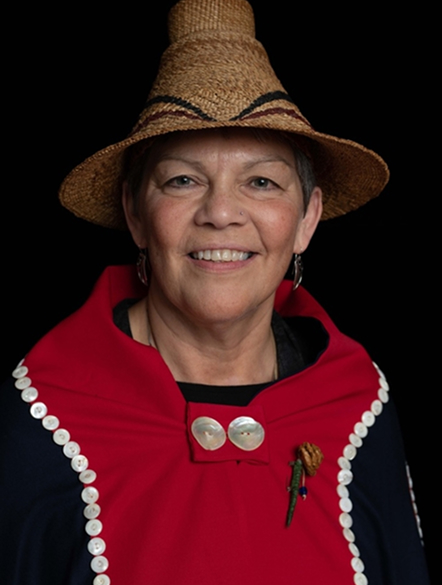
Benjamin Young lives in Hydaburg and teaches students at the X̱ántsii Náay preschool program. His Haida name is K’uyáang. He is a Raven of the Yahgw ’Láanaas clan. Young learned X̱aad Kíl from his chanáa (grandfather), Claude Morrison Kúng Skíis, a respected Haida Elder who lived to the age of 100.
K’uyáang expresses his gratitude for the blessing of his chanáa’s longevity and the patience his grandfather provided while he gained his foundation of X̱aad Kíl. K’uyáang credits his wife, Marita Tolson, for her unwavering support and guidance towards his goal of proficiency. Over the years he has also been influenced by sociolinguist Dr. Jordan Lachler and Gwich’in instructor Hishinlai’ Peter. As a teenager, Young taught his first language classes at SHI’s Latseen Leadership Academy. Through other language projects and programs, Young has worked with Elders Woodrow Morrison, Alma Cook, Annie Peele, Viola Burgess, Charles Natkong, and Erma Lawrence. Young pays respect to all the “die-hards” who valued our way of life and feels it is important to preserve the language in spite of many obstacles associated with westernization.
In the spring and summer of 2017, Young contributed his time to help create a full feature-length film that utilized the Haida language as its sole medium. This film featured the three living variations of the Haida language to create the movie, The Edge of The Knife. In this film, Young acted, taught, and provided language support to help make the movie a visual and audio feast of Haida culture. He was honored to work alongside fluent speakers Delores Churchill Ilskyalas and Jane Kristovich K’ujúuhl. Young graduated from Butler University with a degree in secondary education and began teaching in 2014. He also graduated with a master of arts in First Nations linguistics at Simon Fraser University. He has had many additional roles in language revitalization such as language mentor, researcher, and curriculum developer. Young has also served as a cultural specialist with SHI, the Xaadas Kíl Kuyaas Foundation, and the Ketchikan Indian Community, among other organizations.
Lingít—Tlingit
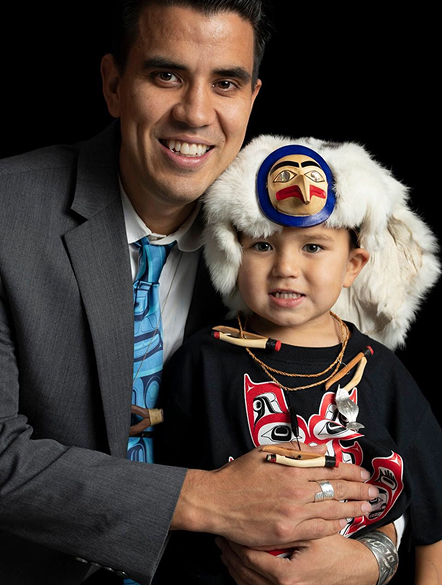
Kaasteen Jill Meserve is Tlingit of the Chookaneidí clan from X̱áay Hít. Kaasteen grew up in Hoonah, Alaska, and went on to attend the University of Alaska Southeast, where she earned her Bachelors of Liberal Arts in Alaska Native languages and studies. Kaasteen previously worked with Sealaska Heritage Institute as a grant manager. She then decided to change her lifeʼs direction and focused more on the Lingít language. She began working as an instructor for Haa Yoo X̱ʼatángi Kúdi, Our Tlingit Language Immersion Nest, a preschool aged program with Tlingit & Haida that teaches through language immersion, where she still works today. In addition to her language work, Kaasteen is a mother and an award-winning Tlingit artist, crafting mainly in beadwork and Ravenstail and Chilkat weaving.
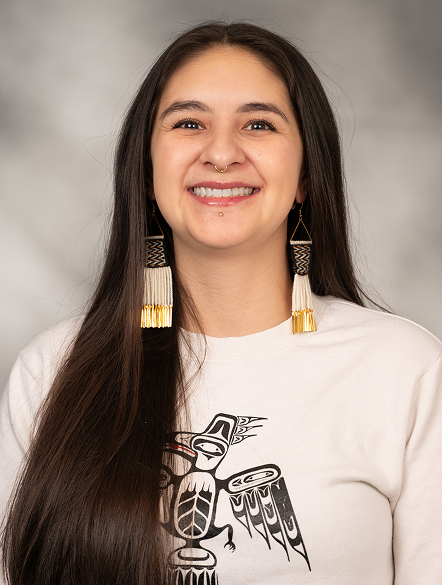
X̱ʼunei Lance Twitchell was born in Skagway and now lives in Juneau. He is of Tlingit, Haida, and Yup’ik heritage and carries the Tlingit names X̱’unei and Du Aani Kawdinook, and the Haida name K’eijáakw. Twitchell is a professor of Alaska Native Languages at the University of Alaska Southeast and has been teaching the Tlingit language since 2004.
He received his Ph.D. in Hawaiian and Indigenous Language and Culture Revitalization at Ka Haka ʻUla o Keʻelikōlani College of Hawaiian Language at the University of Hawaiʻi at Hilo in 2018. His studies are in creating safe language acquisition spaces and achieving revitalization through counterhegemonic transformation, which means a rejection of external definitions and fragmentation and a promotion of the thought world of the ancestors of language movements. In 2017 he completed a Tlingit language workbook based on the teachings of Richard and Nora Dauenhauer, published through Sealaska Heritage. His grandfather, Gooshdehéen Silas Dennis Sr. of Skagway, was his first teacher.