About
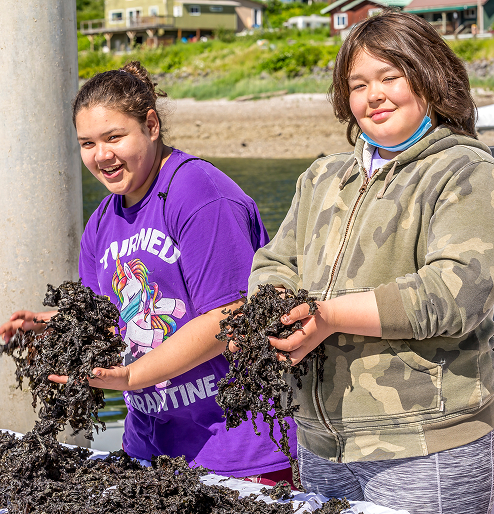
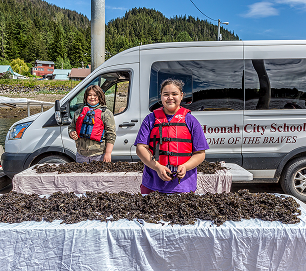
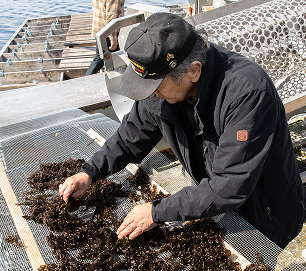
SHI’s black seaweed ethnography project aims to document the harvest, use, distribution, and cultural importance of black seaweed to the Indigenous people of Southeast Alaska. The project currently includes Angoon, Hoonah, Hydaburg, Kake, Ketchikan/Saxman, Klawock/Craig, Metlakatla, Sitka, and Yakutat. The research includes community meetings, harvest trips, and interviews in each community.
Interested in participating? Read our consent form:
Consent Form (opens in a new tab)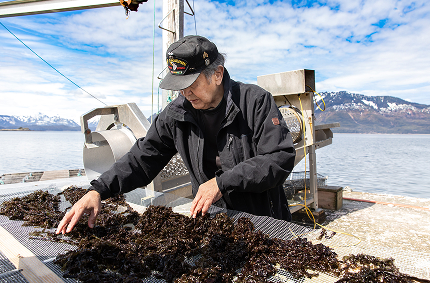
History
In 2023, SHI convened an unprecedented meeting with tribes and tribal members, regional organizations, and scientists from Alaska, Canada, and the Lower 48 to delve into credible reports of variability in the health and abundance of black seaweed, a vital traditional food and cultural cornerstone for Southeast tribes.
SHI organized the meeting after lifelong Tlingit seaweed harvester Irene Dundas reported an alarming and ongoing change in black seaweed (Pyropia abbottiae or laa k’ásk in Tlingit, sgíw in Haida and hla‘ashg in Tsimshian) in the Ketchikan area.
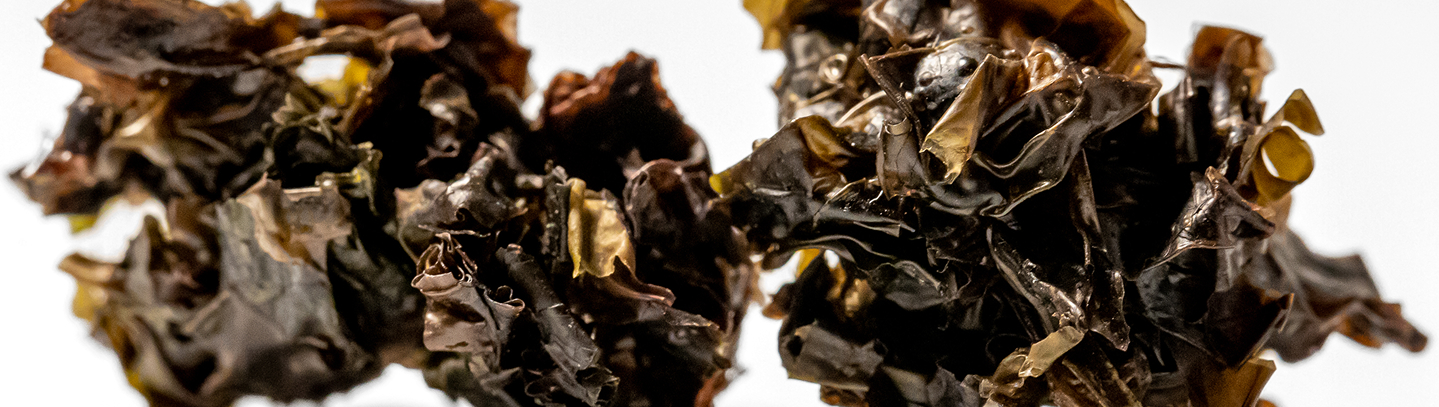
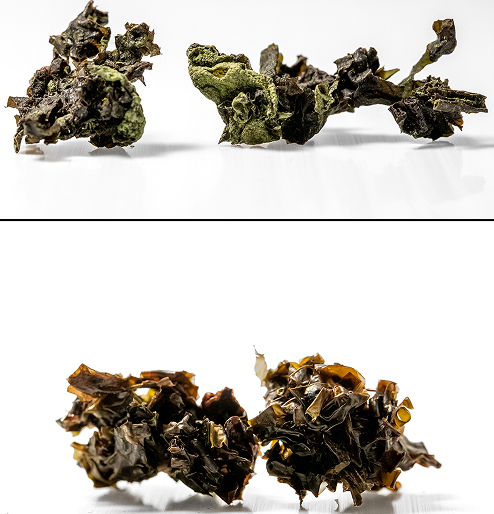
At the meeting in Juneau, Dundas said she first noticed the anomaly in 2021 while her seaweed harvest was drying in the sun at her home. The seaweed was oddly shaped and exhibited green discoloration and dimpling, she said, noting it also tasted off.
“It left a metallic flavor in your mouth and had a different scent when cooking it and a different color,” said Dundas, adding it also broke easily when dried, whereas healthy seaweed retains much of its shape.
She saw the same damage in the algae in 2022 and in 2023 while harvesting seaweed in May and June during its near three-week life cycle. Similar damage has also been reported in British Columbia and other locations, including southern Prince of Wales Island.
Keolani Booth, a tribal councilman for the Metlakatla Indian Community, is a longtime seaweed harvester for his family and community. He told the panel he had also noticed the issue.
“I have the same concerns that Irene has. Where is my way of life going? Those are some of my first memories picking seaweed on the beach with my grandparents,” said Booth, who also noted less abundance in recent years, which has curtailed his ability to share seaweed customarily and widely with the community.
At the meeting, SHI heard a range of reports from scientists about seaweed, including one by Jennifer Clark, Ph.D., who studied the effects of the seaborne phenomenon known as “The Blob” on populations of Pyropia abbottiae while conducting her post-doctoral studies at the University of British Columbia.
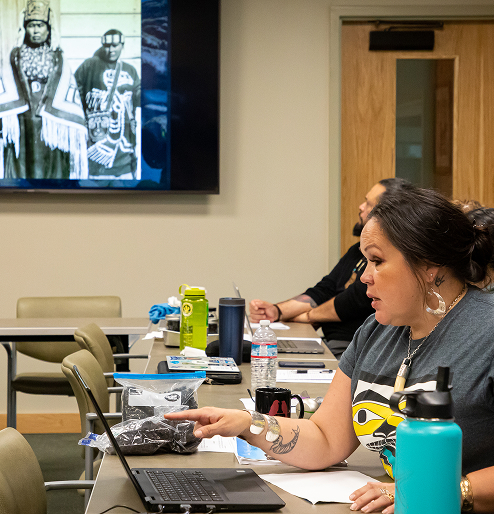
We are heartbroken as tribal leaders when we can’t provide for everyone,” said tribal councilman Keolani Booth. “It weighs on you heavily.
The blob was a mass of warm water that appeared in the north Pacific Ocean in 2014 and persisted into 2015. The blob was followed by an El Nino in 2015 that spanned into 2016. During that time, scientists documented a significant decrease in seaweed abundance, but the algae rebounded from 2017–2019, Clark said.
Others at the meeting also wondered if the reduced abundance of black seaweed could be caused by warmer sea temperatures during the winter, which is when black seaweed produces new seed and may not be experiencing the temperature triggers it is used to. The green crust fouling the black seaweed is the diatom Licmophora, a single-celled algae found in marine environments. It causes the unfavorable flavor and smell and is not a new phenomenon. It has been noted by harvesters in years past, but according to Dundas, it is increasing in frequency and spread.
“It is not clear what environmental factors promote the growth of this diatom, but it can reduce the health of black seaweed by competing for light and nutrients,” noted Tiffany Stephens, Ph.D., a scientist who attended the meeting.
SHI, which was designated by the panel as the coordinator of the project, will identify tribal members and scientists to serve on a committee. The panel will develop a research design and grant proposal to establish a record of Indigenous knowledge and practices and to determine the cause and extent of the damage and whether it poses a long-term threat to seaweed populations.
“We have to develop a research program to find out what’s causing this,” said SHI President Rosita Worl, Ph.D.
The study could incorporate DNA research or metagenomics. That would involve collecting samples from areas of reported damage and areas where seaweed is healthy to find a potential cause, said Dr. Alida de Flamingh, a geneticist from the Center for Indigenous Science, UIUC at University of Illinois, with whom SHI has collaborated with before on DNA studies.
A DNA study, which would incorporate community insights and feedback, could determine whether the microorganisms associated with maintaining healthy seaweed are out of balance, possibly due to environmental stressors, de Flamingh told the group.
Native Lands & Resource Director Ralph Wolfe of the Central Council of the Tlingit and Haida Indian Tribes of Alaska (Tlingit & Haida) also spoke about a resolution passed by the council opposing commercial harvest of seaweed. At the end of the session, Worl called the gathering “historic” because Native people and scientists chose to explore the issue together, integrating Indigenous knowledge and science. Tensions between Native communities and scientists worldwide exist in part because of scientists’ past disregard of Indigenous knowledge and customs.
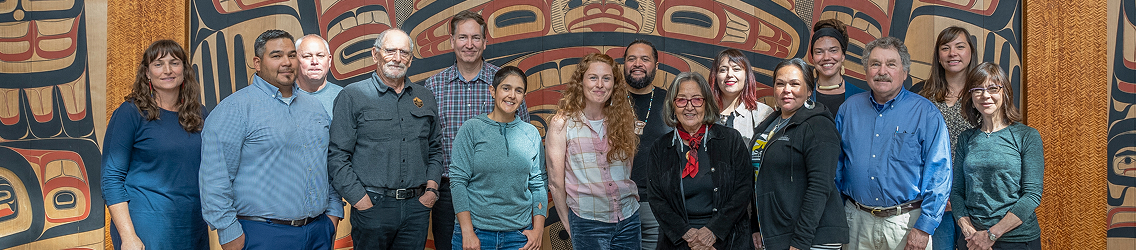
The meeting included tribal representatives from Tlingit & Haida, Sitka Tribe of Alaska, Organized Village of Kake, Ketchikan Indian Community and Metlakatla Indian Community; Indigenous seaweed experts; representatives from Southeast Conference and scientists from the University of British Columbia, University of Alaska Fairbanks, University of Alaska Southeast, University of Illinois and Marine Agronomics.
About Black Seaweed
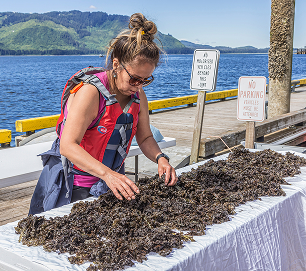
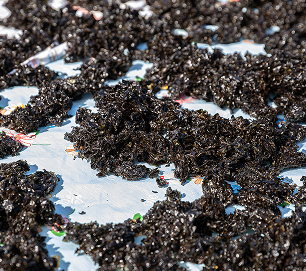
Black seaweed has been a valuable food source for the Native people of Southeast Alaska for thousands of years. The fresh seaweed is gathered at a minus tide and dried in the sun on sheets. Some people dry it immediately, while others let it soak overnight to soften it. After it is dried, pieces are dipped into a solution of water and flavorings, such as sugar and salt, clam juice and minced clams.
When it has almost dried again, it is put through a grinder. It is stored in a variety of ways, sometimes with bits of other wild plants layered in.
Subtleties in the process affect the texture and tenderness. It can be eaten dried or cooked with salmon and salmon eggs.
Seaweed offers the broadest range of minerals of any food, containing virtually all the minerals found in the ocean—the same minerals that are found in human blood. It is a food source of the B-vitamin folate and magnesium and a good source of iron, calcium, and the B-vitamins riboflavin and pantothenic acid. In addition, seaweeds contain good amounts of lignans, plant compounds with cancer-protective properties.
“Black seaweed is a significant and favorite food source for our tribal members. Our Native foods contribute to our health and well-being,” said SHI President Rosita Worl. “It is widely shared by harvesters and distributed in our ceremonial activities where it serves to provide ties to the spirits of our ancestors.”
Seaweed is considered to be such an important traditional resource that it is often seen depicted in Native regalia and other pieces.
This research is funded by the U.S. National Science Foundation (NSF) under grant number 2419460. Any opinions, findings, and conclusions or recommendations expressed in this material are those of the author(s) and do not necessarily reflect the views of the National Science Foundation.