
About
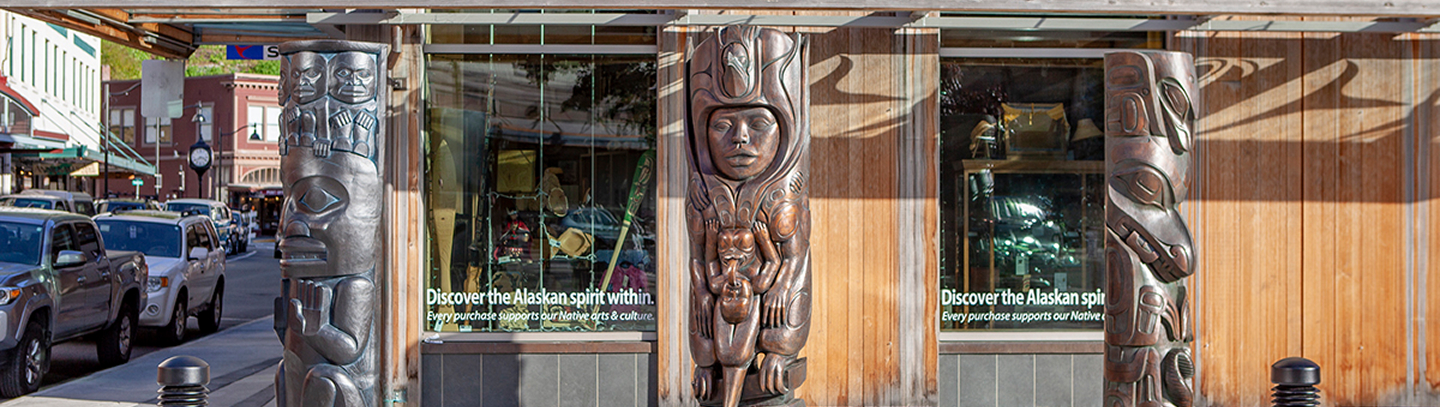
Just outside the Walter Soboleff Building stand three exquisite bronze house posts, which were carved in a traditional way in wood, then cast in contemporary material. The pieces demonstrate that the Tlingit, Haida, and Tsimshian cultures and art are alive, thriving, and evolving through younger generations. The posts, which were unveiled in 2018, were made by three then-emerging master Tlingit, Haida, and Tsimshian artists, including, from left, Tsimshian artist David R. Boxley, Tlingit artist Jackson Polys, and Haida artist TJ Young.
-
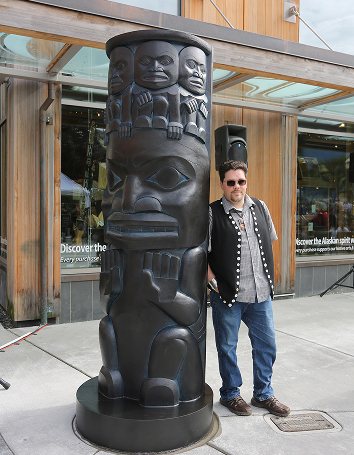
Txeemsm ada txaalpgm pdeegm Ts’msyen (Raven and the four Tsimshian phratries)
Tsimshian artist David R. Boxley, Gyibaawm Laxha of Metlakatla, Alaska, 2018
The post by Boxley depicts Txeemsm (Raven), the mythical hero of ancient Tsimshian stories. Above Txeemsm are four human figures that represent the clans or phratries of the Tsimshian, Boxley wrote.
“Txeemsm’s importance to our people cannot be understated. We literally and figuratively stand on his accomplishments. The vast majority of classic Tsimshian style poles and posts depict primarily human figures, featuring the iconic Tsimshian cheek pyramid and rows of interlocking human figures,” Boxley wrote.
-
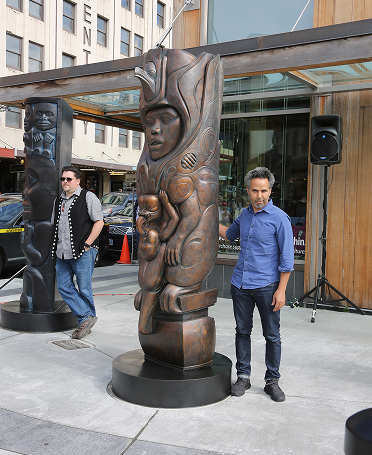
Kaayeekoox̱éik, yú Yéil tláa (Kaayeekoox̱éik, the mother of Raven)
Tlingit artist Jackson Polys, Naakush.áa, of Ketchikan, Alaska, 2018
The post by Polys highlights aspects of the feminine and maternal character not as often represented in carved form. The post depicts the complexity of the way in which Tlingit culture places value on feminine strength, Polys wrote.
“The matrilineal passage of moiety is mirrored in the mother’s passage of Raven into the human world, reminding us of women’s ability to connect us to the power of the natural and supernatural, the power of the sun, to generations past and future. Only by being her son could Raven be granted access, only she can bestow it. She is who allowed for his birth in human form, and despite Raven’s continual peregrinations, she holds the most honored place with the most power,” he wrote.
-
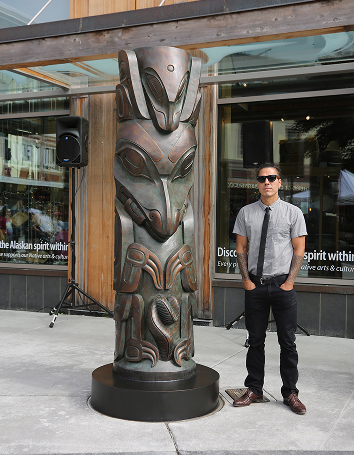
‘Wasguu uu sgáan dlasdángg káajuugang (‘Wasguu hunting two killerwhales)
Haida artist TJ Young, Sgwaayaans, of Hydaburg, Alaska, 2018
The post by Young depicts the image and story of Wasgo, a supernatural figure in the Haida culture known for having the power to successfully hunt killerwhales.
“I’ve illustrated Wasgo mid-hunt with two killerwhales clenched in his teeth. The third killerwhale has temporarily eluded Wasgo and rests on top with his pectoral fins tucked inside Wasgo’s ears,” Young wrote.