
About
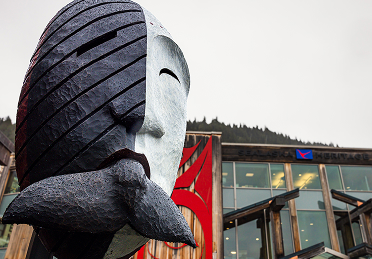
The Sealaska Heritage Arts Campus plaza is home to a spectacular monumental art installation, Faces of Alaska, which features bronze masks that represent Alaska’s five major Native groups, including the Iñupiat, Yup’ik, Alutiiq, and Athabascan. The fifth group is a combination of the Tlingit, Haida, and Tsimshian, who share very similar cultures. The masks were made by master artists from across the state.
To learn more, select a mask:
Choose an installation to read its details. Use arrow keys between choices when enhanced.
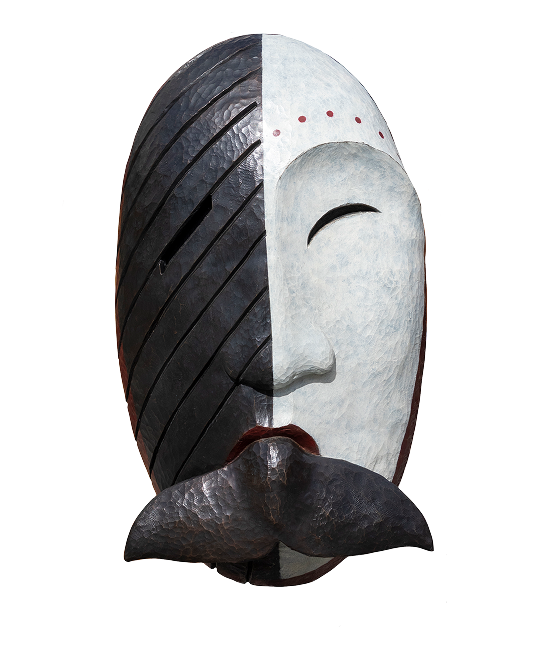
Iñupiat Mask
Design:
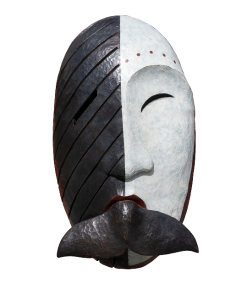
Anatkuq – Agviq kiinaguq-inulik (spirit mask of the whale’s wake)
A traditional shaman’s whaling mask with a shaman’s face on one side and the whale’s-wake on the other side – which represents the waves a whale makes as it rises just before it dives.
When the Anatquk (shaman) performs the dance, it helps the Umailik (whaling captain) with the hunt such as where to place the Umiaq (skin boat) in the right place on the shore or edge of the sea ice.
Inupiat • They occupy northwestern coast of Alaska and the region north of the Brooks Range. • The coastal Inupiat depend primarily on sea mammals, including the massive bowhead whales. • The inland Inupiat subsist largely on the migratory caribou herds.
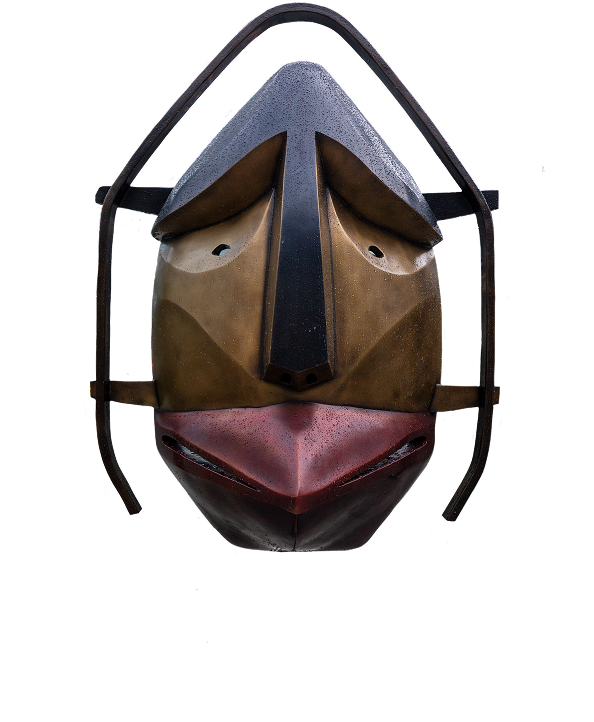
Alutiiq Mask
Design:
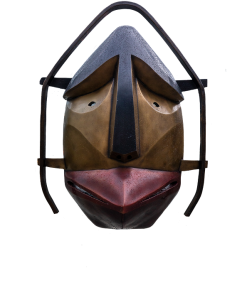
Suqpiaq Alutiiq (messenger mask)
The Alutiiq believe in five worlds within which the ancestors reside. To seek guidance and approval from ancestors, a messenger was sent. A bird spirit was always entrusted to carry the messages. This mask represents both the bird spirit and the human as all spirits contain a human element.
Alutiiq and Unangan • They occupy the southern tip of the Alaska Peninsula and the “Aleutian Chain” of islands. • They are noted for their successful maritime adaptation in hunting sea mammals in the open oceans, most importantly sea lions and whales. • On the Alaska Peninsula, they depend on a mix of caribou and fish.
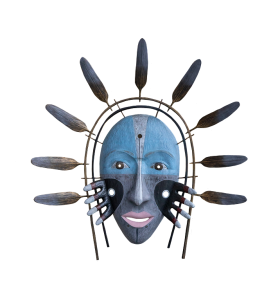
Yup’ik Mask
Design:
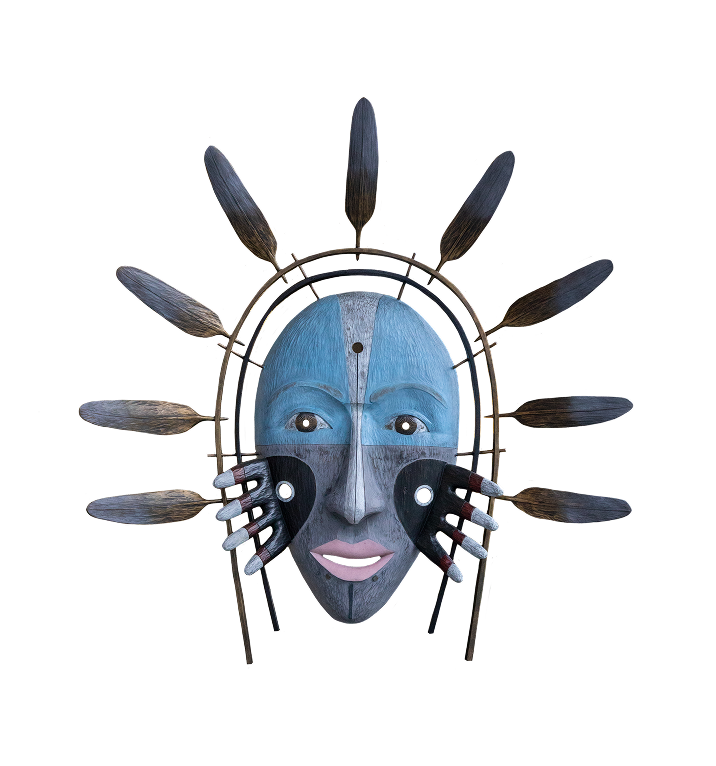
Arctic Lands (spirit mask)
A Yup’ik style mask designed with colors of the North. The bottom half of the mask is about grounding and connecting oneself to the land of Northwestern Alaska. The chin features traditional chin tattoos worn by women and labrets worn by men. The hands are reaching into our humanity, and the fingertips touch the spirits in hopes of connection. The hands do not have thumbs because to prevent the spirits from taking hold. The center of the palms are also center of the cheeks which are open to allow the spirits to flow through. The nose carries a line that reaches to the forehead. This is a reminder to connect and be open to the Creator, Higher Power, God, always reaching outside of self and lifting up others and the spirits of the world around us.
This Yupik style mask was designed to share the power of place and the connection we as people can have with spirits that are all around. Yupik people believe that all things carry energy. As a mask or masks were used in community, stories were shared and spirits were honored in hopes of a healthy hunting and gathering season. People are transformed by masks when they are used and the persons wearing the masks embody the spirits they represent.
Yup’ik • The largest Native group with a population of 30,000 at the time of contact with Westerners. • Occupied a vast region from the coast in Prince William Sound in south central Alaska to St. Lawrence Island in the Bering Strait. • They were primarily dependent on marine mammals and salmon in the riverine systems.
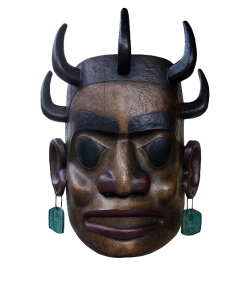
TSIMSHIAN MASK
Design:
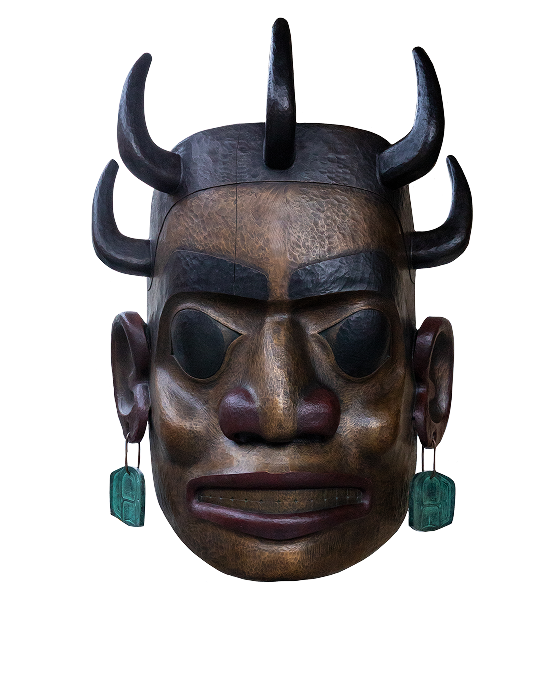
Catcher of Souls (shamanic mask)
The “Catcher of Souls” represents the power of a traditional Southeast Alaska Native shaman. Shaman would capture the soul of an ailing person, protect the soul from harm, and return it to the patient as a way to initiate healing. The artist believes that this shamanic mask is a metaphor for Sealaska Heritage and the work it has accomplished. Through education and art programing, SHI is in essence returning the soul and essential elements of culture back to Native people and healing the communities.
Tlingit and Haida • The Tlingit population numbered approximately 15,000 at the time of contact while the Haida population numbered under 2,000. • The Haida are recent immigrants to Southeast Alaska, migrating from Haida Gwaii in Canada some 200 years before the arrival of Europeans to Alaska. • The Tlingit and Haida live in Southeast Alaska and are primarily dependent on marine resources, notably salmon.
Regions of Alaska
Alaska is the aboriginal homeland of five major cultural groups including the Iñupiat, who have been historically identified as Northern Eskimos; the Yup’ik, historically identified as Southern Eskimos; the Alutiiq and Unangan, who are more commonly referred to as Aleut; the Athabascan; and the Tlingit and Haida. The Tsimshian are a recent group which migrated from Canada to Alaska in 1887. While each of the Indigenous groups speaks a distinctive language and is characterized by cultural differences, they share significant cultural similarities. Today these five major groups are collectively referred to as Alaska Natives.
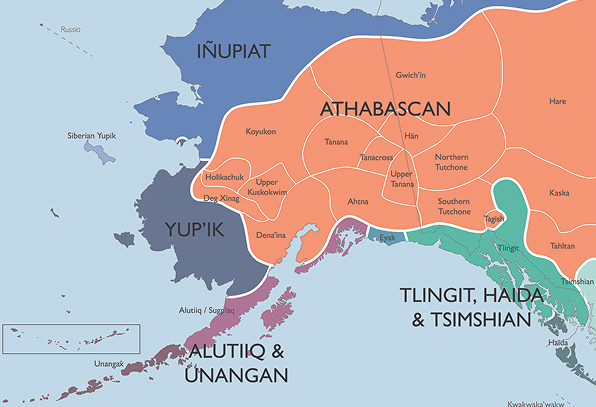
- The Iñupiat were historically referred to as Northern Eskimo.
- The Yup’ik were historically identified as Southern Eskimo.
- The Alutiiq and Unangan were commonly referred to as Aleut.
- The Tlingit, Haida, and Tsimshian are referred to as Southeast Alaska Natives or part of the Northwest Coast tribes.
- A fifth cultural group of Alaska are the Athabascan, who occupy the interior of Alaska. SHI is working to secure a mask from that region to be added to this exhibit.
Overview of Aboriginal Population
The five major groups are collectively referred to as Alaska Natives, although they maintain separate tribal identities and languages. Alaska Native societies are characterized by a group orientation rather than the individualistic emphasis of Western societies. They all believe that humans, animals, and the natural world have spirits and that spiritual relationships exist between them. Their economies and culture are centered on subsistence hunting, fishing, and gathering. At Western contact in 1741, the Indigenous population was estimated at 80,000. In 2020, the estimated Native population was 133,000 or 15 percent of Alaska’s total population of 733,000.
“The masks have a life unto themselves. When you are in their presence, you are linked to the spiritual world in ways that can’t be explained.”
– Perry Eaton, Alutiiq artist, SHI’s Alaska Native Masks: Art & Ceremony exhibit, 2017
Alaska Native Masks
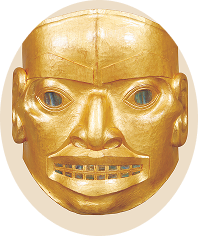
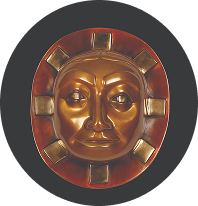
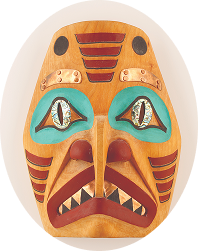
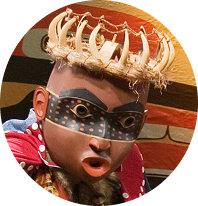
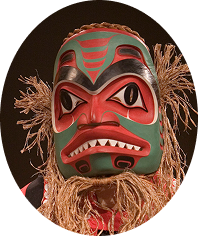
Masks are an ancient tradition among Alaska Natives. They are the medium through which humans interact and communicate with the supernatural world. Masks are used in ceremonies and in dances to evoke, appease, and influence the spirits they depict. Masks are often used in theatrical performances or dance to tell of legendary or historical events. In some regions, masks are used to tease or ridicule fellow village members with the goal of resolving conflicts.
While the basic meaning and use of masks are fairly uniform among the Native societies, their representations vary dramatically both in their realistic interpretations and surrealistic creations among the different tribal groups. Alaska Native masks reflect the artistic creativity and achievements of Alaska’s Indigenous societies.
Spirit Masks
Often masks represent guardian spirits that protect and assist humans in an array of activities. These guardian spirits may also be represented by realistic, portrait-like human face masks that are common everywhere.
While Alaska Native spirit masks share common themes that link the natural to the supernatural world, their visual representations are dramatically different among the various cultural groups. Some spirit masks are portrayed by simple portrait human faces while others have distorted faces almost to the point that they were not recognized as humans. Common among the Yup’ik are surreal masks that were appended with effigies of men, birds, or animals. Some masks are ornamented with fur, feathers, or shredded cedar bark, giving these masks dramatic effects.
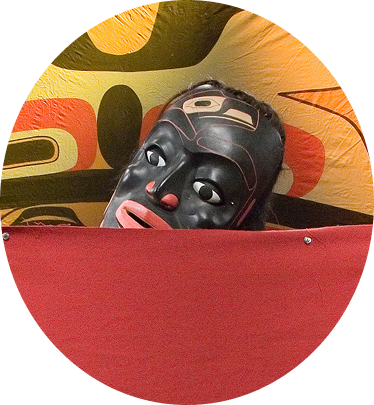
Masks as Art & for Performing Art
Today, Native artists have the liberty to combine traditional designs with modern aesthetics and materials to create contemporary interpretations of traditional masks. As works of art, these masks are the visual representations of the traditions and belief systems of ancestors and are offered for sale to Native and non-Natives alike. For Natives, they are a symbol of their culture and unify them with their traditional heritage. For non-Natives, the masks offer a glimpse into the Native spiritual world.
In addition to pieces for sale, masks are created for theatrical performances, such as SHI’s biennial Celebration. Masks made for sale or performing art differ in that they don’t have spiritual dimensions and are not considered to be sacred objects. However, some dance groups or clans may continue to use their traditional masks, which embody the spiritual dimensions, in the dance performances.
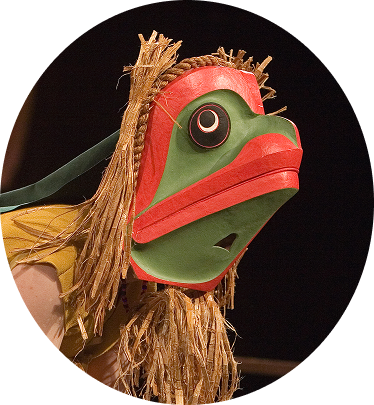
In 2017, SHI opened its Alaska Native Masks: Art & Ceremony exhibit in the Nathan Jackson Gallery of the Walter Soboleff Building. The exhibit marked the first time that SHI had exhibited pieces representing Alaska Native artistic traditions from around the state. The exhibition was created as part of SHI’s advocacy to promote Alaska Native arts, cultures, history, and education statewide. More than 50 masks from the Iñupiat, Yup’ik, Alutiiq, Athabascan, Tlingit, Haida, and Tsimshian were featured in the exhibit, grouped by their cultural significance rather than by geographical divisions or cultural affiliation.